Ultrasound
Ultrasound is a simple, safe, painless diagnostic procedure that bounces high-frequency sound waves off parts of the body and captures the returning "echoes" as images to visualize organs and blood vessels. There is no injection or radiation exposure associated with ultrasound.
How does it work?
Ultrasound can capture moving images of pelvic and abdominal function, breast abnormalities, the male reproductive system, the kidney and thyroid systems (including gallstones), and fetal development, among other applications. When enhanced with a special Doppler technique, ultrasound can also capture moving blood images of the heart and large blood vessels.

What should I expect?
An ultrasonographer will apply a conducting gel to your skin and use a transducer to pass sound waves through your body and capture the echoes. Sound waves travel more easily through liquids than through surrounding tissues and air. Consequently, a full bladder facilitates passage of sound waves through it, making the uterus and ovaries behind the bladder easier to see. When you eat, drink, or even chew gum, you introduce air into the stomach and bowel. Sound waves do not penetrate air, making it harder to see target organs.

Images are instantly captured on a television-like monitor and transferred to film or videotape for a radiologist to review and interpret. The exam typically takes 20-60 minutes.

For specific instructions/restriction on exam preparation, please refer to our Patient Prep Instructions.
Echocardiography and Vascular Imaging
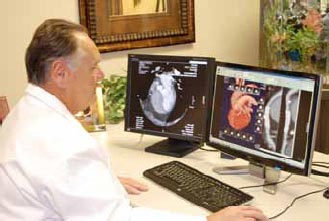
This test uses sound waves to produce an image of the heart that provides a window into function. Depending on the type of echocardiography test they use, doctors can learn about the size, shape, and movement of your heart muscle. This test can also show how the heart valves are working and how blood is flowing through the heart. Echocardiography can also give doctors information about your arteries.

For specific instructions/restriction on exam preparation, please refer to our Patient Prep Instructions.
Stress Echocardiography
The Stress Echocardiograph is a test that uses high-frequency sound waves (also called ultrasound) that provide a moving picture of the heart. The Stress Echocardiograph uses radioisotope dyes that are injected into the bloodstream (called nuclear stress tests).

The procedure is similar to exercise stress testing with the added capability of producing one, two, or three-dimensional views of the heart.

For specific instructions/restriction on exam preparation, please refer to our Patient Prep Instructions.

Frequently Asked Questions:

Q: Why do I need to have a full bladder for a pelvic ultrasound?
A: Sound waves travel more easily through liquids than through surrounding tissues and air. Consequently, a full bladder facilitates passage of sound waves through it, making the uterus and ovaries behind the bladder easier to see.

Q: Why can't I eat or drink anything before my abdomen ultrasound?
A: When you eat, drink, or even chew gum, you introduce air into the stomach and bowel. Sound waves do not penetrate air, making it harder to see target organs.

Q: If there are ulcers in my stomach, can you see them?
A: No. Due to the intestinal gas (air) in the stomach and intestines, it's hard to see these areas with ultrasound.

Q: Can ultrasound be harmful to my baby?
A: To date, no proven ill effects have been seen doing regular ultrasound exams on pregnant women.


Home | About Us | Services | Patient Information | Scheduling | What's New | Resources | Locations | Contact Us
727-849-8492 | Send email to: info@diag1.com
Copyright © 2008 - Florida Institute for Advanced Diagnostic Imaging