|  |
FIFADI adds Cardiovascular
Magnetic Resonance to its arsenal for fighting heart disease.
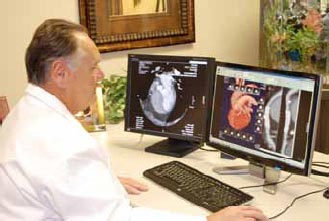
| How do we determine possible heart death
after a cardiac episode or heart attack? Cardiovascular MRI
can be used to clearly distinguish dead from damaged, but
still living, heart muscle. This is essential, when making
a decision to perform angioplasty to restore heart function.
Cardiologists believe that cardiac MRI can help a significant
number of heart patients. MRI provides crisp 3-D views of
the cardiac anatomy with no interference from adjacent bone
or air. Its image quality surpasses that of echocardiography—a
more common imaging technique—and MRI is able to capture views
that echocardiography cannot. |
|
Cardiac MRI can show physicians how well
the heart muscle is contracting, as well as precisely reveal areas
of damage tissue. The non-invasive, radiation-free technique is
especially useful for evaluating such conditions as coronary artery
disease, heart failure and congenital heart disease. Already a
valuable diagnostic technique, cardiac MRI is still in its infancy
and is complemented at the institute with Coronary CT Angiography.
“We are paving the way for Cardiac MRI and
Coronary CT Angiography, “ said Dr. Steven Strobbe, president,
FIFADI. “For the first time, we can look at the heart in a totally
non-invasive environment with precision and anatomical detail
never seen in the past or with other imaging techniques. We are
able to evaluate the patency of coronary artery bypass grafts
and native vessels after coronary stent placement, evaluate congenital
coronary variants, and follow the progress after procedures such
as angioplasty. Using 3-D and ultra thin, contiguous slice technology
we can also screen and evaluate patients with ischemic heart disease
and coronary artery disease. Coronary MRI and CTA are capable
of providing an accurate, noninvasive and rapid diagnosis of coronary
heart disease. Identifying soft plaque can be used clinically
or in screening, allowing the clinician to target treatments such
as statins.
The FIFADI is the site of a concentrated
research study aimed at developing the science of Cardiac MRI.
Being able to distinguish damaged from dead heart tissue is one
of the main benefits of MRI technology. We are looking at the
metabolism of the heart muscle cells. A recently installed “speeder”
package was installed with the Toshiba Excellart MRI scanner creating
super fast images that can clearly capture a beating heart. FIFADI
devotes its imaging center to cardiovascular disease and heart
imaging. As an official Toshiba Show site, The FIFADI currently
operates the multi-million dollar high field MRI, 16-slice CT
and Open MRI in its outpatient-imaging center located in Port
Richey, FL.
|