|
|  |
Magnetic Resonance Imaging (MRI) Open
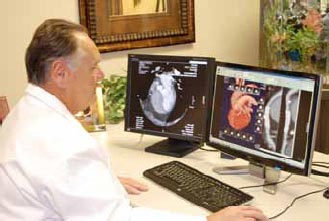
MRI provides exquisitely detailed images of body tissues unobtainable through other procedures. This helps your physician make earlier, more accurate diagnosis and initiate treatment sooner. MRI is safe and convenient for you, with no known side effects. And its rate of accuracy in detecting suspected conditions is so high that other tests may be avoided. |  |

 |
Our revolutionary Open MRI increases the availability of MRI to patients with large physiques, those susceptible to claustrophobia, children and the elderly. This is in addition to our "traditional" MRI units.
An open MRI scan takes approximately 30-45 minutes, because the magnetic field strength is lower and therefore requires more time to acquire images for a quality exam. The technologist will help you lie down on a cushioned table and an imaging device called a "coil" will be placed around the area of the body being scanned. The area of the body being scanned will be in the center of the scanner. For most procedures--with the exception of the head, neck, or shoulder areas--your head will remain outside the scanner. When you are comfortably positioned, the table will move into the magnet opening. As the exam proceeds, you will hear a muffled thumping sound for several minutes at a time as the images are taken. It is important to lie as still as possible during this part of the exam. The resulting images will be reviewed and interpreted by a radiologist and a report will be sent to your doctor.
|
| Because of the magnetic field, remove any metallic objects such as jewelry, watches, and hairpins. Inform the technologist of prior surgeries or metal implants such as pacemakers or aneurysm clips.
|  |
An MRI is a completely painless test, and because the MRI machine uses magnetism, you are not exposed to any radiation like you would be with an x-ray machine. MRI cannot be done if you have a pacemaker. For specific instructions/restriction on exam preparation, please refer to our Patient Prep Instructions.
Please notify a member of our staff if there is a chance you may be pregnant!
Frequently Asked Questions:
Q: Why does an open MRI scan take so much longer than high-field MRI?
A: Exam times are longer on an open MRI because the magnetic field strength is lower and therefore requires more time to acquire images for a quality exam.
Q: Is the scanner a tube?
A: No. The open MRI scanner has a wide, non-constricting space. It is open on all four sides, as well as the front and back.
Q: Will my head be out of the scanner?
A: The area of the body being scanned will be in the center of the scanner. For most procedures--with the exception of the head, neck, or shoulder areas--your head will remain outside the scanner.
Q: Is there any risk?
A: MRI is very safe. There are no health risks associated with the magnetic field or the radio waves used by the machine, nor have any side effects been reported. Patients with a pacemaker or certain types of aneurysm clips should not have an MRI.
|
|
|