| What
is CT- PET Fusion Imaging?
It is the very latest imaging technology that combines
the anatomical detail of 16-slice CT (Computerized Tomography)
technology with the molecular metabolic information derived from
PET (Positron Emission Tomography).
Almost everyone is familiar with CT or "CAT"
scans, which have been commonplace in medicine for approximately
30 years. Today's CT scanners are better and faster than ever,
capable of producing up to 64 "slices" of imaging in 0.5 seconds.
Still, they are sometimes unable to detect tiny, often sub-clinical
malignancies. Left undetected (and therefore untreated), these
malignancies will grow and possibly metastasize, making their
eventual treatment more challenging. Even when they are detectable
on CT scans, they merely appear as abnormal masses and there is
often uncertainty with regard to whether they are malignant or
benign.
Dedicated PET imaging is a nuclear medicine
procedure in which a radioactive isotope, 18-fluorodeoxyglucose
(FDG), is injected intravenously. The glucose, or "sugar" component
of the FDG allows it to be "taken up" in cells seeking sugar.
Because cancer cells are sugar-seekers, a disproportionate amount
of FDG is captured within malignancies, making even tiny tumors
visible during the scanning process.
PET therefore, succeeds where conventional
CT fails, because it provides for the imaging of very small tumors,
and while a diagnosis of cancer cannot be made without a biopsy,
PET can prove to be a strong indicator. PET has also proven very
useful in staging cancer patients, sometimes eliminating the need
for surgery.
Unfortunately though, PET scans do not show
nearly the anatomical detail that CT scans do, and while physicians
can often identify potential malignancies, they are sometimes
unsure of their exact location. This conundrum has led to the
development of software technology that combines PET and CT imaging
simultaneously and creating "fused" the best features of both
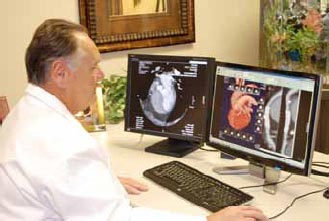
CT and PET on a single image. In essence, it provides the best
of both the CT and PET worlds.
PET-CT fusion is covered by most insurances
and by Medicare. Medicare is continually adding to its lists of
approved clinical indications for PET and PET-CT. Currently, Medicare
authorizes PET and PET-CT for:
- Solitary pulmonary nodules
- Non-small cell lung cancer
- Colorectal cancer
- Melanoma
- Lymphoma (Hodgkin's and Non-Hodgkin's)
- Head and neck cancer (excludes CNS)
- Esophageal cancer
- Breast cancer
- Certain neurologic and cardiac indications
Several other cancers are currently
under review:
PET-CT fusion is useful for more than just
"finding" and staging cancers; it can play an important role in
monitoring a tumor's response to chemotherapy or radiation therapy.
In many instances a follow-up PET-CT scan can be performed after
the first cycle of therapy to gauge the impact that the therapy
regimen has had. If there has been a significant reduction in
the tumor's size, it can safely be said that the therapy has been
successful and if indicated, can be effectively continued. On
the other hand, should a follow-up PET-CT show little or no tumor
response, a change in treatment might be indicated. This, obviously,
can significantly improve treatment outcomes, shorten treatment
durations and provide substantial cost savings.
If you would like to learn more about PET-CT
fusion or would like for a Florida Institute for Advanced Diagnostic
Imaging representative to speak about PET-CT to a group that you
belong to, please contact us at (727) 849-8492. |